CASE STUDY
Owning local discovery in Sydney’s CBD.
  • SYDNEY
Owning local discovery in Sydney’s CBD.
A Sydney CBD hotel operating under an international brand flag

Activation: 01 December 2023, Zone (local search)
Second activation: 01 October 2024, Helium (organic search)
Scope: Zone local search programme throughout, preceded by a single Helium optimisation alignment in December 2023, and joined by the ongoing Helium organic search programme from 01 October 2024
Measurement Period: 01 December 2023 – 28 February 2026 (27 months)1

Hotel Context

The hotel is a large property on the southern edge of Sydney’s CBD. It traded under a different name until 2022, when a change of ownership, and the management agreement that followed it, saw the property rebranded under one of an international hotel group’s flags.2


The hotel’s current microsite, built on the group’s own booking-engine platform, went live in mid-October 2023 as part of that transition, and Google Analytics tracking begins at that point. At the time of engagement the site carried effectively no established organic or local search footprint. It was a new domain, competing in one of Australia’s most contested accommodation markets, under a brand name that was itself new to the property, while the legacy name still held much of the hotel’s accumulated search equity. The practical consequence was a heavy reliance on intermediary channels to generate demand.

OmniHyper’s engagement began on 01 December 2023. A single Helium optimisation alignment was applied in December 2023 to ensure the new site was technically sound and correctly structured. Zone, OmniHyper’s local search programme, commenced on the same date and ran continuously through to the end of the measurement period. On the strength of Zone’s early results the client extended the engagement, adding Helium, an ongoing organic search programme, from 01 October 2024. Helium works on the hotel website. It does not act on the Google Business Profile or Google Maps.

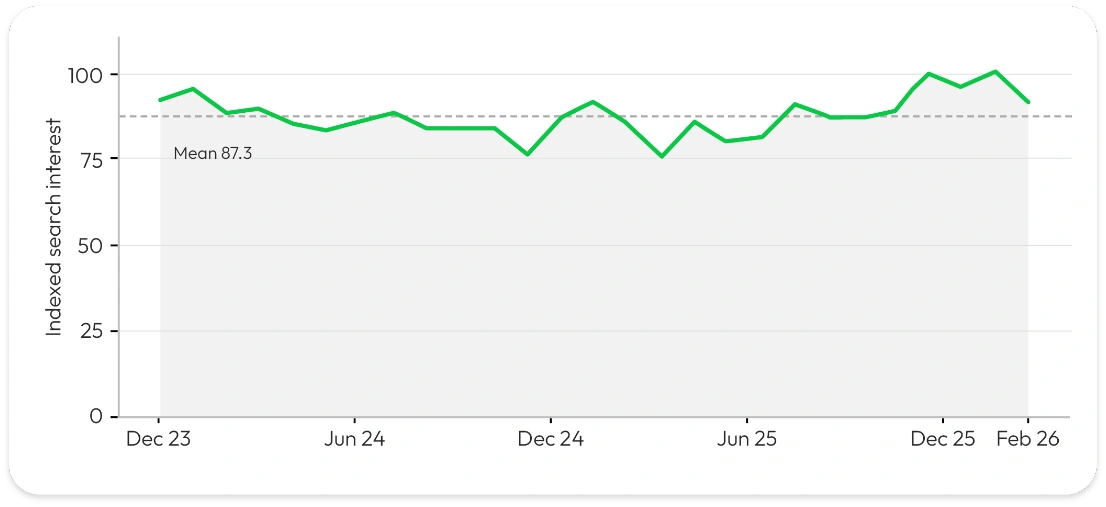
Underlying market demand did not do the work. Google Trends indexed search interest for “hotel” in New South Wales moved within a narrow band of 76 to 100 across the measurement period, averaging 87.3, and finished at exactly the level it started: 92 in December 2023 and 92 in February 2026. Annual averages were 85.6 in 2024 and 87.2 in 2025.3 Sydney’s CBD accommodation market remained stable and highly competitive. What changed over this period was the hotel’s share of that demand, and where that demand was resolved.

Figure 1: Indexed Google search interest for “hotel”, New South Wales, 01 December 2023 to 28 February 2026. Source: Google Trends.
The Challenge

The hotel faced four connected challenges:

  • No established local search footprint, despite standard listings management already being in place. A newly launched microsite on a new domain, with minimal presence in Google Maps, the local pack and the local discovery environments where in-market accommodation searches are resolved. Like every property in the group, the hotel already ran Yext, which keeps the hotel’s name, address, phone number and core details accurate across roughly 35 primary channels. That is listings accuracy, not local search performance, and on its own it was not producing visibility.
  • A brand transition still working its way through search behaviour. Demand was fragmented across the legacy name, the new brand name, shortened variants, and the street address. Search Console data for the period shows measurable click volume against the property’s address as a query in its own right.4
  • Brand-name collision inside the group’s own Sydney portfolio. The hotel carries one of the group’s largest brands in Sydney, with several sister properties from the same brand family in and around the CBD. Generic brand queries carry very high volume but resolve poorly for any single property: over the period, the brand-plus-city query returned 43,165 impressions but only 398 clicks (0.92% click-through rate), and the brand-plus-hotel-plus-city variant returned 27,045 impressions for 96 clicks (0.36%).4 Without a distinct local identity, demand of this kind leaks to competitors, including sister properties.
  • Low exposure to high-intent, location-based demand beyond brand. Searches such as “accommodation central station sydney”, “sydney central accommodation” and “hotel sydney central” describe exactly the guest this property serves, and the hotel was not competing for them.

The objective was clear: capture in-market, high-intent local demand at the point of decision, consolidate both legacy and new brand search behaviour onto the hotel’s own assets, and grow direct performance.

Approach

Budget was constrained, so the approach prioritised the activities that would deliver the fastest and most measurable return, in sequence rather than in parallel.

  • Foundation first: a single Helium optimisation alignment, December 2023. A one-off technical and on-page optimisation of the new microsite, to ensure the site was sound, correctly structured and properly optimised. This was an alignment exercise, not an ongoing organic search programme.
  • Zone as the continuous programme, from 01 December 2023. Ongoing local search optimisation focused on Google Maps and local discovery: Google Business Profile optimisation and maintenance, local content and posting, listing and citation consistency, and continuous management of local search visibility.
  • Zone was built to sit on top of Yext, not beside it. Yext is standard across the group’s estate and maintains accurate name, address, phone number and core property details across roughly 35 primary channels. Zone integrates with and wraps around Yext, extending distribution to more than 130 channels, and adds the work Yext does not perform: optimising the Google Business Profile, building local content, and actively managing local search visibility. Yext keeps a listing correct. It does not make a hotel rank.
  • Local search was prioritised deliberately. Local search typically delivers measurable movement within 30 to 90 days, against the longer horizon of traditional organic search. It also converts across more than one pathway: online bookings, phone enquiries and walk-in traffic. For a property that needed early commercial impact, this was the fastest route to incremental demand.
  • Helium added from 01 October 2024. Ten months in, with local search performance established, the client extended the scope to include Helium, OmniHyper’s ongoing organic search programme. Helium works on the hotel website: technical health, site structure, content depth and organic authority. It does not act on the Google Business Profile or Google Maps, which remain Zone’s territory.
  • Continuous measurement. A portfolio of 37 local and brand-adjacent search terms was tracked without interruption from December 2023, alongside Google Business Profile performance, Google Search Console and Google Analytics 4, reported through the OmniHyper dashboard.5

This phased approach allowed early commercial impact while establishing a foundation for broader search performance over time, which is what the addition of Helium in October 2024 went on to build.

Observable Changes

01 December 2023 to 28 February 2026, unless stated otherwise. Zone ran throughout. Helium, added 01 October 2024, acts on the hotel website only, so ranking and Search Console figures from that date reflect both programmes.

Search ranking

  • A net gain of 471 ranking positions across the tracked portfolio. Across 37 tracked local and brand-adjacent search terms, 21 finished in the top three.6
  • The largest gains came from non-brand, location-based terms, not from brand. “oxford street sydney accommodation” moved to 6th (up 95 positions), “accommodation in sydney central station” to 21st (up 80), “sydney central accommodation” to 8th (up 68) and “hotel sydney central” to 9th (up 44).6

Search visibility

  • 1.87 million search impressions and 25,897 clicks, at an average position of 18.2. Google retains Search Console data for a rolling window only, so these are absolute volumes from approximately January 2025.4
  • The hotel now owns its own name. Its full brand-plus-location name delivered 7,857 clicks from 74,775 impressions at an average position of 2.77, with close variants adding a further 2,563 clicks.4
  • The property began surfacing against Sydney event and attraction demand. Search Console records non-brand clicks against queries such as “nrl grand final accommodation”, “group accommodation sydney” and a range of major-event searches.4

Local and map discovery

Google retains this data from January 2025 only, so these figures understate the period. Helium does not act here.

  • 872,500 Google Business Profile impressions. Approximately 499,100 from Google Maps and 373,400 from Google Search, and 684,000 on mobile, confirming predominantly in-market, on-the-move demand.7
  • 105,000 direction requests and 9,092 phone calls. The clearest available signals of in-market intent, and demand that no web analytics platform captures.7
  • 18,813 website clicks from the profile. As is standard across the group’s estate these resolve to the group’s central booking site, not the microsite, so they are additional to the website figures below.7

Website engagement

Tracking begins with the microsite launch in mid-October 2023. No prior-year baseline exists.

  • 71,520 sessions from 49,500 users. 42,031 sessions were engaged, an engagement rate of 58.77%.8
  • Organic search became the dominant channel. Organic Search delivered 49,290 sessions, 68.9% of the total, at a 62.55% engagement rate.8
  • The audience is the right audience. 68.8% of users were in Australia, consistent with a domestic, in-market, local-search-led acquisition pattern.8
Commercial Indicators

Commercial outcomes are drawn from the group’s own internal revenue tracking system, not from web analytics. It records two channels: the hotel website and Google Maps. Helium acts on the website only, so the Google Maps line remains attributable to Zone throughout, and the first 10 months of the engagement predate Helium entirely.

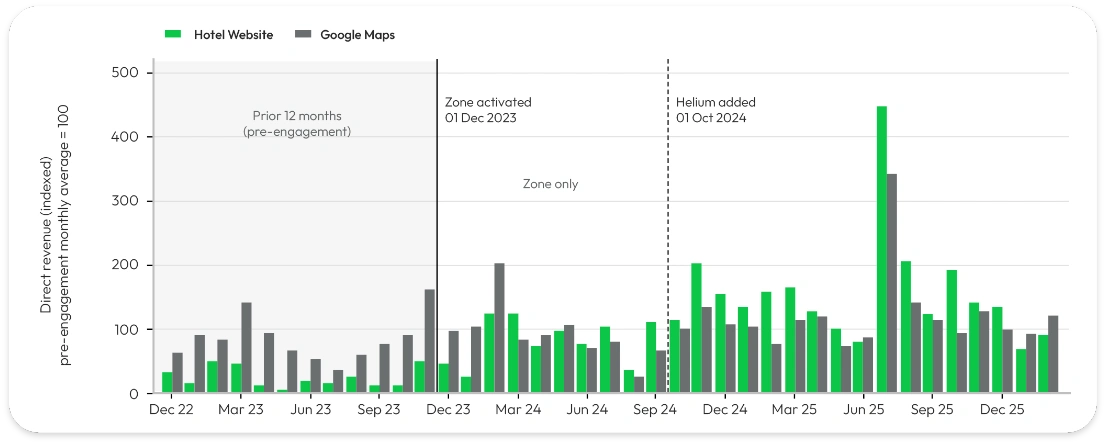
  • Direct revenue grew across the measurement period on both tracked channels. Revenue, bookings and room nights were recorded across the hotel website and Google Maps between 01 December 2023 and 28 February 2026. Google Maps accounts for 46.3% of that revenue and is attributable to Zone throughout.9
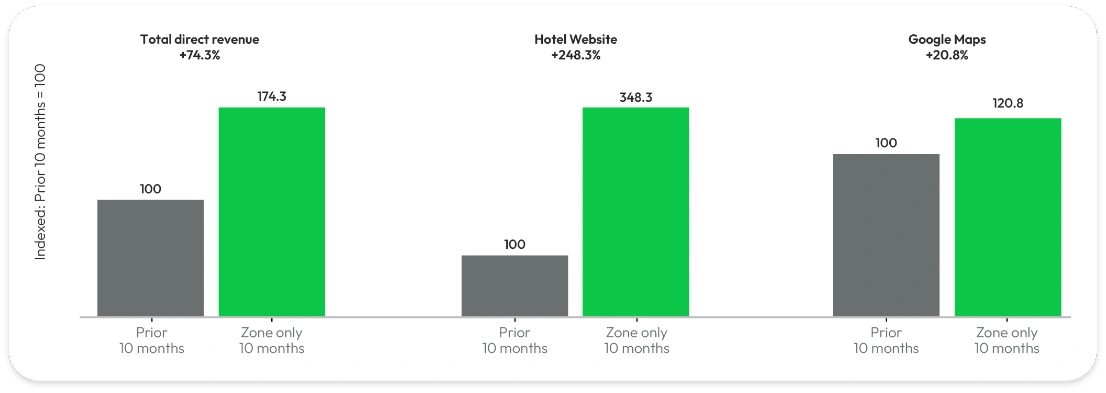
  • Zone in isolation: the first 10 months delivered a 74.3% increase in direct revenue. Before Helium commenced, December 2023 to September 2024 grew 74.3% against the equivalent preceding 10 months, with bookings up 71.3% and room nights up 63.0%. The hotel website line grew 248.3% and Google Maps 20.8%, all of it before Helium existed. The website line also reflects the new microsite maturing, having gone live only in mid-October 2023; the Google Maps line does not.9
  • Google Maps grew across the full period, on a channel Helium never touched. Indexed to a pre-engagement monthly average of 100, Google Maps averaged 121 across the Zone-only window and 158 from October 2024 to February 2026, 57.7% ahead of the pre-engagement rate.9
  • The uplift arrived quickly and then compounded. The first six months delivered a 68.2% uplift in direct revenue. Annual direct revenue then grew a further 45.0% from 2024 to 2025.9
Figure 2: Monthly direct revenue by channel, indexed to the pre-engagement monthly average = 100, December 2022 to February 2026, showing the twelve months before Zone activation and the addition of Helium on 01 October 2024. Source: group internal revenue reporting (hotel website + Google Maps).
Figure 3: Zone in isolation. The first 10 months of the engagement (December 2023 to September 2024), entirely before Helium commenced, against the equivalent preceding 10 months. Indexed to the preceding 10-month period = 100. Source: group internal revenue reporting.

These figures are a floor, not a ceiling. That system tracks the hotel website and Google Maps only, so the 9,092 phone calls and 105,000 direction requests generated by the Google Business Profile appear nowhere in them. Google Analytics sees less still: across the same 27 months it captured only 70.9% of the revenue the group attributes to the website alone, and none of the Google Maps revenue, because that pathway resolves to the group’s central booking site and never touches the microsite.

Interpretation

Underlying demand was flat. Google Trends shows search interest for accommodation in New South Wales finishing the period exactly where it started. The hotel’s performance was not flat: 471 net ranking positions gained, 21 of 37 tracked terms in the top three, 71,520 website sessions, 872,500 Google Business Profile impressions in a 14-month window, and direct revenue up 74.3% in the group’s own system before Helium was added. The market did not change. The hotel’s share of it did.

No single model can isolate one programme’s contribution in a multi-touch environment, and this case study does not attempt to. What it offers instead is six independently owned sources moving in the same direction across the same window, each listed in the appendix and checkable without reference to OmniHyper.

Separating Zone from Helium

Helium was added on 01 October 2024 and works on the hotel website. Two views therefore isolate Zone. The first is time: across the ten months before Helium commenced, direct revenue was already up 74.3% year on year. The second is channel: Google Maps, at 46.3% of the total, sits outside Helium’s scope entirely, and grew 57.7% against its pre-engagement monthly average after Helium was added. The growth did not begin when Helium arrived, and it is not confined to the channel Helium touches.

Yext is standard across the group’s estate, so every comparable property in the group’s Sydney portfolio had the same listings accuracy over the same period. Accurate listings were the baseline, not the variable.

Local search should be read not as a digital marketing channel, but as a driver of total demand at the property level. A significant share of the demand it generated, 9,092 phone calls and 105,000 direction requests in a 14-month window, never reaches an analytics platform. Last-click attribution alone will systematically undervalue it.

Appendix: Claim-to-Source Map

This case study was intentionally designed to minimise reliance on agency-reported metrics. Every outcome below is drawn from a system owned by Google, by the group, or by the hotel itself, so that each claim can be independently verified.

# Claim Source Window Brand access
1. Underlying demand flat: indexed search interest for “hotel” in
NSW held between 76 and 100 (mean 87.3); 92 at the start of the
period and 92 at the end
Google Trends Dec 2023 to Feb 2026 Public, reproducible
2. Net gain of 471 ranking positions across 37 tracked local and
brand-adjacent terms; 28 improved, 2 unchanged, 7 declined
Rank Tracker, via OmniHyper dashboard Dec 2023 to Feb 2026 Via dashboard
3. 21 of 37 tracked terms in positions 1 to 3; 29 of 37 in the
top 10
Rank Tracker, via OmniHyper dashboard As at 28 Feb 2026 Via dashboard
4. 1,870,000 search impressions and 25,897 clicks; average
position 18.2
Google Search Console Google retained window, approx. Jan 2025 to Feb 2026 Direct (Google property)
5. Hotel’s full brand-plus-location name: 7,857 clicks from
74,775 impressions, average position 2.77, CTR 10.51%
Google Search Console Google retained window Direct (Google property)
6. Google Business Profile: 872,500 impressions (499,000 Maps,
373,000 Search)
Google Business Profile Google retained window, approx. Jan 2025 to Feb 2026 Direct (Google property)
7. Google Business Profile: 105,000 direction requests, 9,092
phone calls, 18,813 website clicks (resolving to the group’s
central booking site, not the microsite)
Google Business Profile Google retained window Direct (Google property)
8. Microsite sessions 71,520 from 49,500 users; Organic Search
49,290 sessions, 68.9% of total; engagement rate 58.77%
Google Analytics 4 Dec 2023 to Feb 2026 (absolute; no prior baseline, tracking
begins Oct 2023)
Direct (GA4 property)
9. Direct revenue split Hotel Website 53.7% / Google Maps 46.3%;
bookings and room nights reconcile on the same basis
Group internal revenue reporting (hotel website + Google Maps) Dec 2023 to Feb 2026 Group internal
10. Zone in isolation, before Helium: revenue +74.3%; hotel website
+248.3%; Google Maps +20.8%; bookings +71.3%; room nights +63.0%
Group internal revenue reporting Dec 2023 to Sep 2024 vs Dec 2022 to Sep 2023 Group internal
11. First 12 months vs prior 12 months: revenue +74.6%; bookings
+70.3%; room nights +63.4%
Group internal revenue reporting Dec 2023 to Nov 2024 vs Dec 2022 to Nov 2023
(10 of 12 months pre-Helium)
Group internal
12. First 6 months vs prior 6 months: revenue +68.2% Group internal revenue reporting Dec 2023 to May 2024 vs Dec 2022 to May 2023 Group internal
13. GA4 captured only 70.9% of the revenue the group attributes to
the hotel website, and none of the Google Maps revenue (46.3%
of direct revenue, outside Helium’s scope)
Google Analytics 4; group internal revenue reporting Dec 2023 to Feb 2026 Direct (GA4) + Group internal